Let me paint a familiar picture: It’s Monday morning, and you’ve got three urgent project requests in your inbox. The youth pastor needs graphics for next week’s game night, the missions team wants a video for their upcoming trip, and your senior pastor just mentioned Easter is coming up (yes, you knew that already!). How do you decide what gets your attention first?
On our Communications team, we solve this through what we call our tier system. It’s not just about organization – it’s about serving our ministries better by being intentional with our resources. Here’s why it works and how you can build one for your church.
Understanding the Why
Before we jump into the how-to, let’s talk about why this matters. When I first started in church communications, every request felt equally important. But here’s the truth: not every event needs the same level of promotion. Some events are designed to reach your entire community, while others serve a specific ministry group. Your resources should reflect that difference.
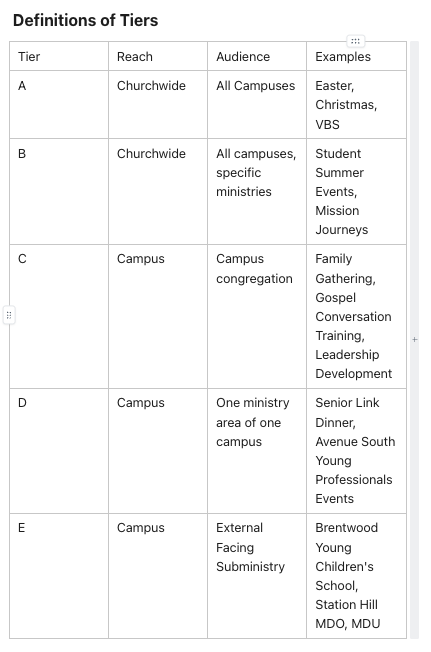
Breaking Down Our Tier System
Here’s how we structure our tiers:
Tier A (All Hands on Deck)
- Events: Easter, Christmas, VBS
- Why: These are our highest-influence events to reach people outside our church
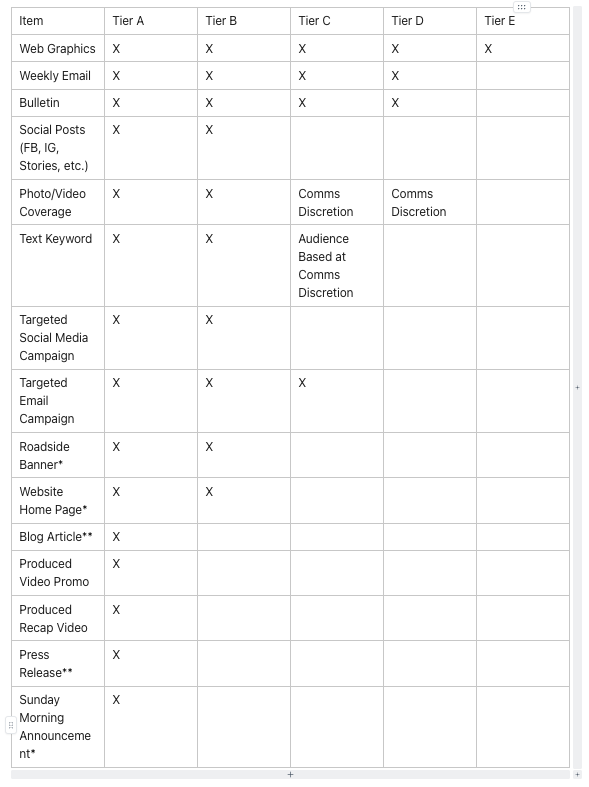
- What They Get: Full creative package, external marketing, building signage, the works
Tier B (Church-Wide Focus)
- Events: Large ministry events affecting all campuses
- Why: Important for church unity and mission
- What They Get: Comprehensive internal promotion, some external marketing
Tier C (Campus-Wide)
- Events: Single campus celebrations or major ministry moments
- Why: Builds campus community
- What They Get: Campus-specific promotion package
Tier D (Ministry-Specific)
- Events: Individual ministry activities (about 85% of our requests fall here)
- Why: Serves specific groups within the church
- What They Get: Basic graphics package, digital bulletin mentions, simple promotion
Making It Work in Real Life
Here’s the key: this isn’t just about saying “no” – it’s about setting clear expectations up front.
When a ministry leader submits a request, they need to tell us:
- Which tier their event falls under
- How it aligns with our church’s vision
- Their target audience
- Their goals for the event
This helps us make sure we’re giving the right resources to the right projects. Plus, it helps ministry leaders think strategically about their events before they even come to us.
Building Your Own System
Ready to create your own tier system?
Start here:
1. List Your Regular Events
Make a list of everything you promote in a year. Yes, everything.
2. Group by Impact
Sort these events by their reach and strategic importance to your church’s mission.
3. Define Resource Packages
Create clear checklists of what each tier receives. For example, our Tier D events always get:
- One graphics package
- Two weeks in the digital bulletin
- Basic promo copy
4. Document and Share
Create a simple guide that explains your tiers and share it with your staff. This prevents confusion and reduces those “but can you just…” conversations.
The Real Game-Changer
You know what’s really powerful about this system? It’s not just about organization – it’s about helping your church focus on what matters most. When a ministry leader comes to me with a request, I can ask, “How does this align with our church’s mission?” Sometimes that conversation helps them realize they need to rethink their approach entirely.
Remember: your goal isn’t to say “no” more often – it’s to say “yes” to the right things in the right way.
Start small. Maybe begin with just three tiers instead of five. The important thing is to have a system that helps you make decisions confidently and serve your church effectively.
Want to take this further? Spend an hour this week listing out your church’s events and start grouping them into potential tiers. You might be surprised at how quickly patterns emerge – and how much clearer your priorities become.
You’re not just managing projects, you’re stewarding resources to help your church share the gospel more effectively. That’s worth taking the time to get right.